Finding Our Agency in the Age of AI
By Ryan Kurt, Founder and CEO, The AI Lab
November 3, 2026
Introduction
I've worked in AI since 2013, including nine years at Narrative Science, a CIA-backed pioneer in natural language generation. We were building AI that wrote narratives from data years before ChatGPT and Claude brought AI-generated language to a mass audience. The technology was much narrower in scope than today's tools, but helping people put language-generating AI to work has been central to my career from the beginning. After Salesforce acquired Narrative Science, I became part of the founding Agentforce team. Several colleagues share that history.
Today, we collaborate with leaders at Harvard Business School's AI Institute, and I serve as the Executive in Residence for AI-Enabled Education at the University of Iowa's Tippie College of Business. This June, one of our senior advisors and I helped lead the AI track at the Borgo Dialogues at the Vatican, including time with Pope Leo XIV, exploring AI, ethics, safety, and human dignity.
Coaching vs. Consulting
AI is dominating conversations. We hear serious questions about jobs, the economy, and AI's broader consequences. Those questions matter. But when the conversation stays at the level of entire industries or society, it can leave people feeling that AI is something happening to them, with little they can do about it.
In our daily work, we also see people gaining more control over their work and their lives. That experience is why we emphasize coaching. Getting started with AI often requires less technical expertise than people expect. The deeper change is learning a new way of thinking and working: developing habits, recognizing opportunities, and building processes that evolve with experience.
Over my career, I've repeatedly seen companies hire outside firms expecting a fast, sweeping transformation around advanced technology, only to find that, despite significant resources in time and capital, the hoped-for change never takes hold. Outside expertise can help, but people inside the business have to develop the understanding and confidence to make it part of everyday work. That learning cannot be outsourced.
Outside expertise can help, but people inside the business have to develop the understanding and confidence to make it part of everyday work. That learning cannot be outsourced.
AI makes this especially clear. To be useful, it needs the knowledge of the people doing the work: the context behind a decision, the exceptions to a process, and the judgment that comes from experience. Integrating that knowledge into new ways of working takes their participation. A workflow also needs to keep changing as people learn and the tools improve.
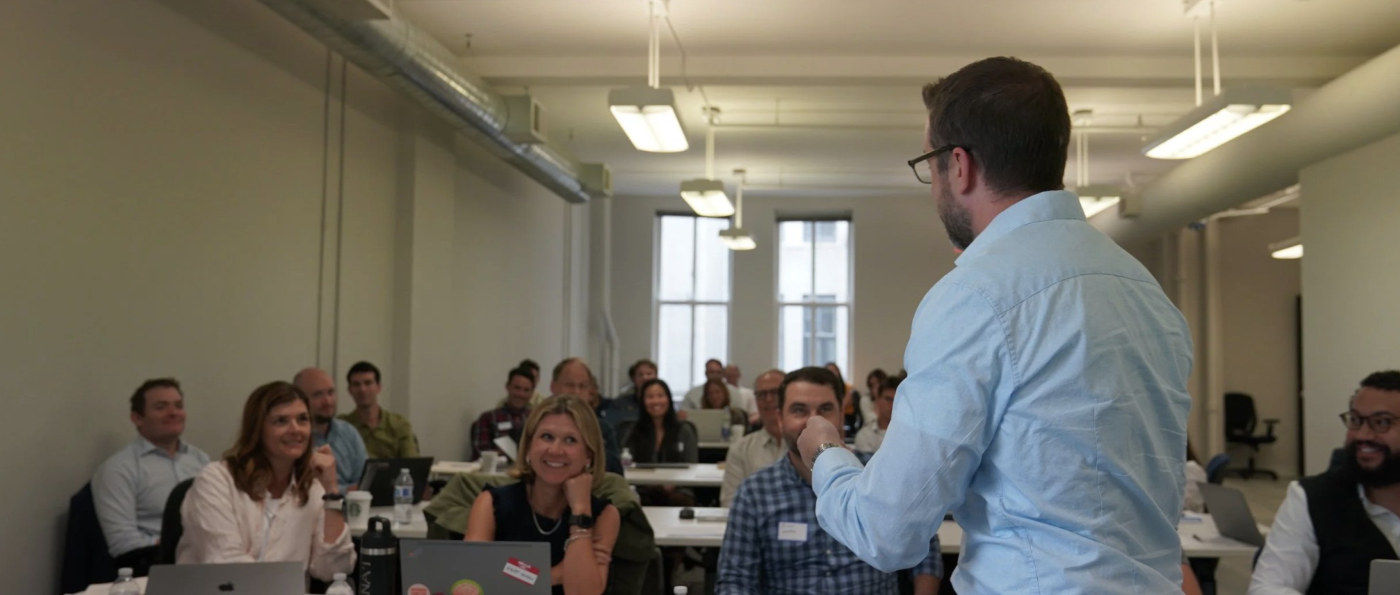
Our role is to teach and guide that process. A person on your team and an AI Lab coach start with a real problem, explore how AI might help, identify the information it needs, and learn how to check the results. They try it, review what happened, and improve it. When access or integration becomes a barrier, that may mean working with IT. Throughout, the person closest to the work builds the ability to own and improve the result.
Coaching is how individual agency becomes organizational change. As people gain confidence, they spot more opportunities, share what works, and help colleagues build on it. New habits and workflows begin to spread across teams and functions. Coaching helps a company develop the capability to keep that progress going from within.
AI with Agency
One current coaching effort is helping a finance leader develop a planning model into something a wider team can use and maintain. The work includes testing it against past results and helping other analysts learn to run and adjust it. That illustrates the approach: start with a business need, support the person doing the work, and build toward a capability the team can share.
From Our Community
Christina Baldwin — SVP, Human Resources, Calumet Inc.
Christina Baldwin, SVP, Human Resources at the specialty manufacturing company Calumet explains, "The people closest to the work understand our challenges better than anyone. Our goal is to give them the tools to solve those challenges in new and better ways. That's why we built our partnership with The AI Lab around coaching, not consulting. We're not asking someone else to come in and solve one problem for us. We're teaching our people how to combine AI with their own expertise to solve problems themselves. That creates a multiplier effect: every problem solved builds capability that can be applied to the next one. Over time, AI becomes embedded in how we work, not as a replacement for our expertise, but as a tool that amplifies it."
"I'm really excited about Calumet's next steps with The AI Lab and I think we're going to see just exponential growth at all levels of the organization," Christina said. "We're going to be able to not just put these tools in the hands of all employees, but teach everyone how to make them truly impactful to our business."
One of the clearest patterns we've observed is that the companies making the most progress with AI have leaders who are focused not just on productivity, but on making people's working lives better. When people have the tools, coaching, and confidence to improve how they work, the benefits extend beyond individual productivity. They identify new opportunities, help colleagues, and develop better ways of working. Stories like these begin repeating across teams and departments, and over time, those improvements compound.
This also changes how we think about the future of work. As companies become more AI-native, existing roles will evolve and new ones will emerge. While much of the conversation about AI focuses on efficiency and reducing headcount, our experience has often been different. We've seen companies making significant progress with AI discover that they need more people, sometimes doing different, higher-value work, as new opportunities and capabilities emerge.
AI can create efficiencies, but it also expands what organizations are capable of doing. And as that capacity grows, so do the opportunities to serve customers, improve operations, and pursue work that previously wasn't possible. The implications will differ across companies and roles, but the potential goes well beyond simply doing the same work with fewer people.
This is why leadership matters at every level. People need time to learn, guidance when they get stuck, and permission to experiment responsibly. Leaders also need to listen to the people doing the work. They often see opportunities that would be difficult to identify from a distance. A useful idea can begin anywhere in the organization.
Once someone solves a problem and sees what is possible, they tend to notice another opportunity. Their confidence grows alongside their ability. Hands-on experience also gives them a clearer understanding of where AI helps, where it makes mistakes, and where human judgment remains essential. They have more to contribute when their company or community is deciding how AI should be used.
Our community brings together people from different companies so they can learn from one another's experience. If you'd like to explore what I've described here, I'd be happy to talk with you myself or connect you with others in our community. You can hear directly about what they've tried, what's worked, and what they've learned—and decide what might be useful in your own work.
The AI Lab helps leaders and their teams make AI useful in everyday work. We bring together an invite-only community of executive peers, hands-on coaching for the people closest to the work, and AI advisory that gives leadership teams fractional Chief AI Officer guidance. No hype. No jargon. Just practical strategy from leaders who've done it before.