CO-SERVICE: YOUR NEW COMPETITIVE MOAT
Accelerating Time to Value with AI Through Dynamic Collaboration
By Mary Grace Glascott and Ryan Kurt
July 27, 2026
Your Customer Is Your New Competitor
Executives are all drinking from a firehose of AI information. They know a seismic shift is occurring, that their industries will never be the same, and that the winners of the future will look drastically different than the ones of the past. Yet, they lack full clarity on exactly what is happening, where this is going, and what to do now.
While rapidly exploring how to use AI on their own, and consequently dealing with the increasing costs of frontier models, executives are also turning to outside help to build AI tooling to help them keep up. For decades, the value proposition of these professional services firms — be it law, accounting, consulting, or insurance — rested on a single foundational pillar: information asymmetry. The expert spent years accumulating specialized knowledge, and the client paid a premium to access it. The client defined a problem, and the provider returned with a finished asset. It was a clean, transactional, "do this for me" relationship.
Artificial Intelligence has shattered this paradigm. Today, professional service firms are no longer just competing with rival agencies; their number one competitor is becoming their own customer armed with AI. Customers now have direct access to the same analytical depth, data-processing power, and institutional synthesis as top-tier external consultants. They are no longer passive recipients of a static deliverable. Instead, they are actively utilizing their own internal AI engines to critique, deconstruct, and verify external work in real time. Customers are dropping contracts into their own tools to review NDAs, drafting their own SOWs, generating cash flow statements, and auditing insurance policies — all without ever talking to an outside human expert first.
Consider a CFO responsible for her company's risk management. She can drop her insurance policies and claims history into her own AI tool and receive a customized coverage recommendation. Simultaneously, her outside broker pings her, eager to present the best options generated by their proprietary AI. The problem? The two tools give different advice. Even a slight variance in output creates a profound psychological shift. Trust is instantly altered.
Instead of forcing clients onto rigid, vendor-specific frameworks that become quickly stale, forward-thinking service providers must position AI as a shared utility. Rather than just another tool added to a toolkit, AI can emerge as the foundational operating system for knowledge work — offering deep, contextually aware capabilities that are accessible to both parties simultaneously.
The Co-Service Model vs. The Legacy Approach
In a traditional engagement, the client outlines a need, and the service provider works behind a curtain, eventually delivering a finished product. In a new Co-Service Model, this shifts from a transactional "do this for me" dynamic into a deeply integrated, collaborative "help me do this better" approach. When done correctly, service providers deliver a low-friction, high-quality experience where clients can analyze their own coverage or cash flow, and then talk to an expert who can walk them through how to analyze it better themselves.
Insurance brokerages, accounting firms, and law firms should be the ones walking their clients through how to use AI tools within their specific domains, establishing clear thresholds for when a complex issue should escalate to human oversight. When the provider is involved early in teaching the client how to leverage these capabilities, an entirely new level of trust is established.
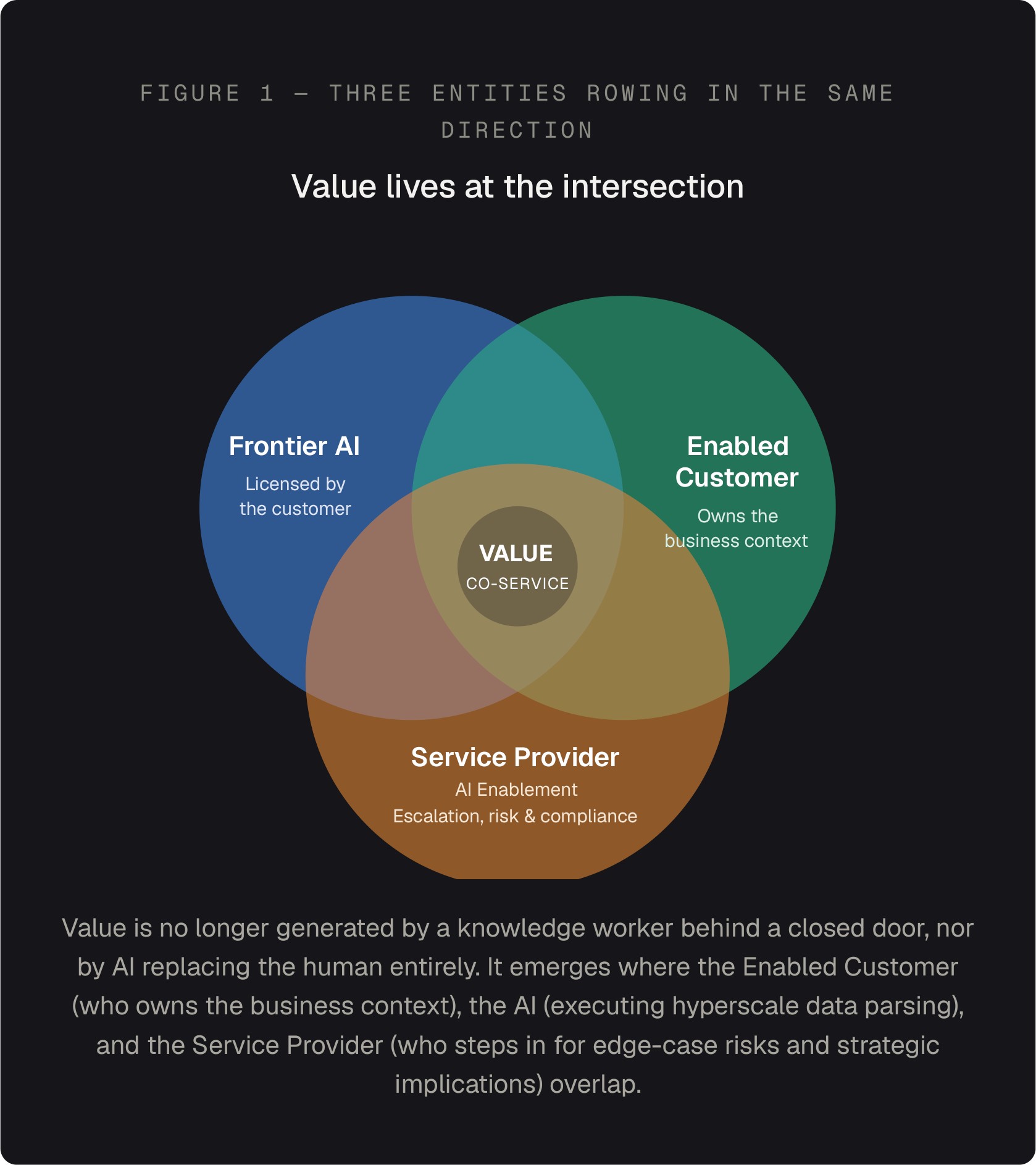
When a firm shifts to a Co-Service framework, the competitive moat is established through three uncopyable layers:
- Relational. By training clients to use frontier AI within your domain, you embed your firm into their daily workflows — transitioning from an interchangeable vendor to an indispensable strategic partner.
- Velocity. Instead of wasting capital building isolated tech infrastructure, a co-service posture lets your team ship tailored domain workflows at a speed standalone software companies cannot match.
- Contextual. The ultimate protection against disruption is a highly enabled workforce that pairs deep, lived-in industry knowledge with AI-native execution — a human moat where experts move upstream to handle compliance, risk, and strategic edge cases.
Becoming a Forward-Deployed [Lawyer, Broker...]
As organizations scramble to adapt, many fall into a structural trap: over-relying on outsourced "Forward-Deployed Engineers" (FDEs) or temporary AI consulting squads who implement AI integrations and products without instructing the customer on how to maintain and grow that implementation. While the market initially rewarded firms that rushed to implant outside technical experts into client systems, this strategy introduces severe long-term liabilities:
- The Scarcity & Retention Crisis. High-level talent capable of entering a complex business, diagnosing its cultural nuances, successfully training custom AI agents, and continuing to troubleshoot and perform necessary maintenance is rare and expensive.
- The Morale & Culture Tax. Parading outside consultants into boardrooms to configure cold systems erodes institutional trust and tanks morale among employees who fear displacement.
- The Loss of Domain Context. AI systems are only as powerful as the organizational context fed into them. Outside contractors lack the deep, lived-in knowledge of your specific business.
External partners should be used for structured, technical heavy lifting — data cleanup, data engineering, building pipelines. But organizations must be careful not to reflexively insert a third-party contractor between their internal talent and the keyboards where core AI context is defined. To bridge legacy operations and the co-service future, forward-thinking firms must get to market first by becoming their own Forward-Deployed Business Expert — the "Forward-Deployed Accountant," "Forward-Deployed Lawyer," "Forward-Deployed Broker," etc.
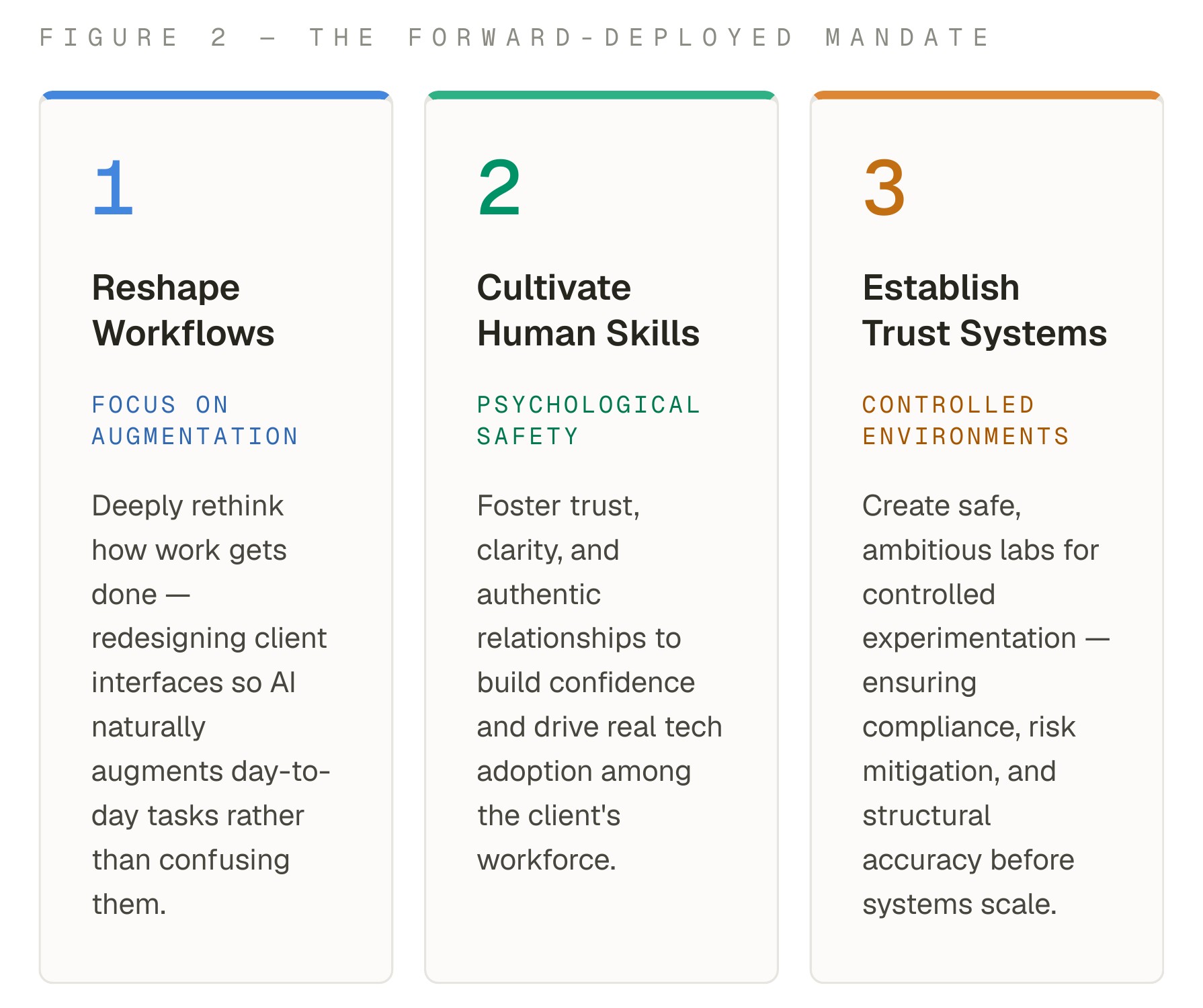
Rather than building proprietary, clunky applications that don't align with their client's own AI roadmap, this role's mandate is to guide the client's internal workforce through the transition, becoming an ongoing, embedded resource. Who better to deploy a financial analysis capability within a client's business than an accountant? Imagine an outsourced CFO calling a client to say:
"I'm going to set up a Claude financial analysis agent for you to use on your own. I'll update it and maintain it. When you have deep questions, click this button and I'll chime in. I'll also show you how to do your baseline taxes fast and cheap. When you call me to discuss a major financial move, I'll already have full context — because your AI system will have drafted me a brief to prep me."
Because every company possesses a completely distinct culture, operational cadence, and data ecosystem, this work cannot be commoditized or replaced by a centralized software update. This continuous learning and operational resilience becomes an organization's true, uncopyable competitive moat.
Empowering the Workforce of Today: Enablement over Replacement
For the past several quarters, the public markets have aggressively rewarded corporate layoffs executed under the banner of "AI efficiencies." This short-sighted strategy has a rapidly approaching expiration date; as technology democratizes, the market will stop rewarding headcount reductions and begin heavily rewarding AI-native professionals who can multiply their output. However, a stark labor paradox has emerged: while annual U.S. job postings requiring AI skills have increased, a profound global skills gap prevents workers from doing more than typing basic prompts into a chatbot. Winning the next decade of knowledge work requires a deliberate shift: halting retrenchment, accelerating internal reskilling, and designing explicitly for a Co-Service infrastructure.
Unlocking this value requires realizing that shoehorning AI into legacy workflows rarely produces the expected ROI. AI is not just a faster replacement for a legacy task, but a fundamentally new relationship with technology that requires a complete redesign of how work gets done. Instead of tracking superficial compliance metrics like license seats or token use, firms must measure what matters: employee capability, engagement, and the quality of work reaching the customer. Every use case must be built to amplify human abilities rather than imitate them, making the professional's role more visible with AI than it was without it. By investing in capability through training and clarity through governance, firms embrace the constraints that remove anxiety and clear the mental space required for creative experimentation.
This transformation ultimately succeeds or fails based on cultural safety, requiring firms to build trust before scaling tools. To foster authentic adoption, workers must retain real agency — including meaningful override rights and clear accountability — while leaders must openly acknowledge the identity loss that occurs when AI absorbs specialized tasks. Rather than issuing top-down mandates, change should be co-designed with the workforce and led by internal champions who drive peer-to-peer learning. When executives model this behavior publicly by sharing their own technical learning curves and failures, they turn their workforce into an uncopyable competitive moat.
Why The AI Lab
At The AI Lab, we help executives turn AI's promise into real-world execution through strategy, peer community, and hands-on training. Rather than building isolated software that sits apart from how you actually work, we equip your own domain experts to put AI to work inside their fields — coaching them to operate differently themselves.
That's our model of enablement: we don't do the work for you, we make your people capable of doing it better.
We don't build the moat for you — we turn your people into the moat.